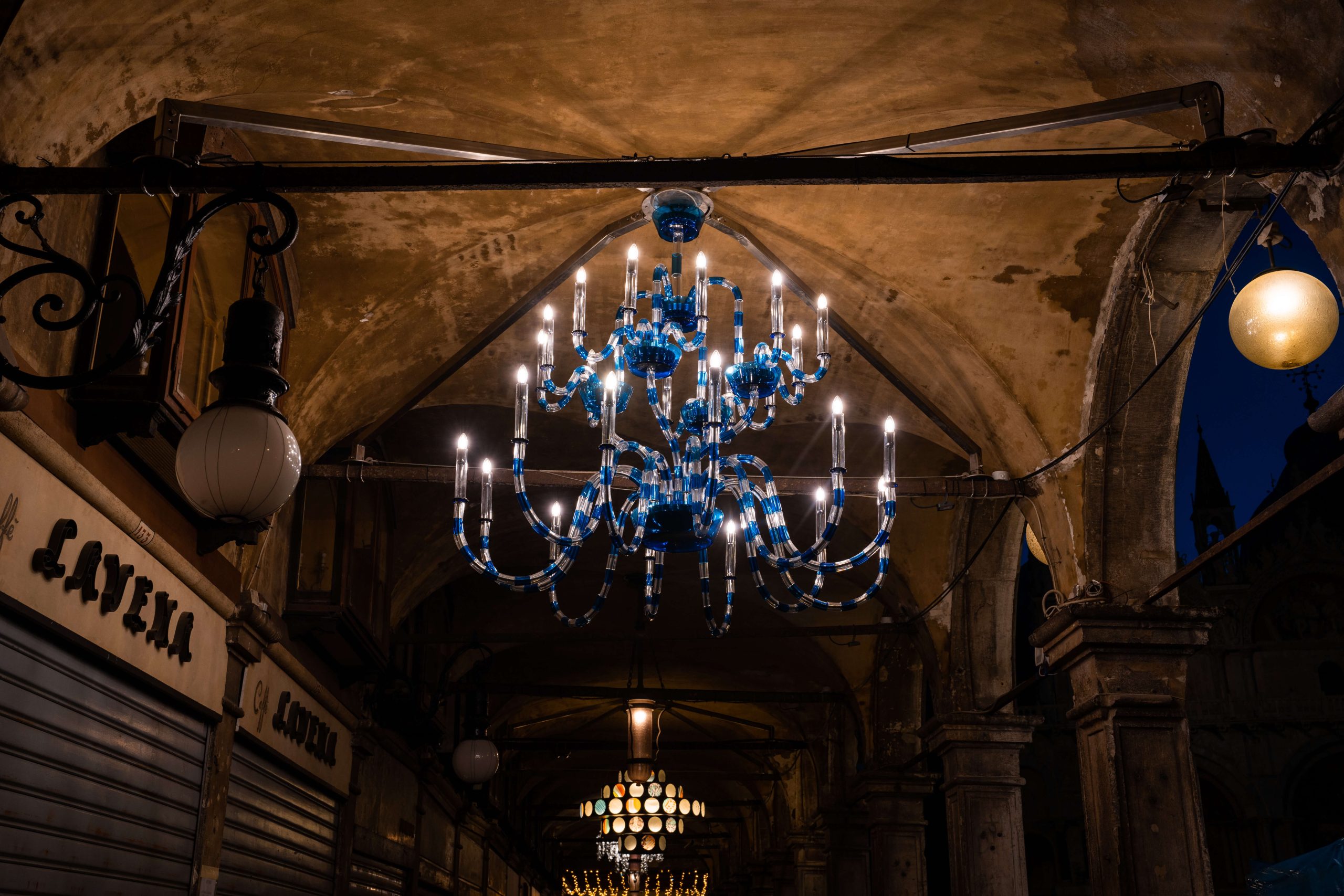
Murano glass is returning to illuminate St Mark’s Square this winter with the second edition of Murano Illumina il Mondo (Murano Lights Up The World). Organised and promoted by The Venice Glass Week and Comune di Venezia, the project will shine a spotlight on the island of Murano via the winning alliance between glass and contemporary art.
From 22 November 2024 to 4 March 2025, eleven magnificent chandeliers will be exhibited in St. Mark’s Square – “the most beautiful drawing room in the world” – under the vaults of the Procuratie Vecchie. The chandeliers are the result of the collaboration between internationally renowned artists and designers and some of Murano’s most prestigious glass furnaces.
The participating artists and designers were invited to reinterpret an everyday object, the chandelier, using both traditional and modern glassmaking techniques. Their designs were realised by some of Murano’s most talented glass masters, renowned for their remarkable technical skills, centuries-old techniques and innovative experimentation.
Murano Illumina il Mondo is made possible thanks to the participating artists and furnaces, and the collaboration between The Venice Glass Week, Fondazione Musei Civici di Venezia, Le Stanze Del Vetro, Fondazione Giorgio Cini, Pentagram Stiftung, Istituto Veneto di Scienze Lettere ed Arti, Consorzio Promovetro Murano and Comune di Venezia.
The AZ2024 chandelier is a collective project realised by the students of Istituto Abate Zanetti together with master Eros Raffael. The chandelier is composed of organic spheres made of mirrored crystal and sandblasted crystal, along with decorated spheres recalling the colours of the Rezzonico chandelier. The central disc is a mirror.
Marina and Susanna Sent have always been fascinated by the “bilancia” fishing nets used in the Northern Lagoon of Venice. The clean, essential lines and geometric shapes of these nets were the inspiration for a pendant lamp, made by hand using the lampworking technique. The elements are woven onto fishing line.
Kimiko Yoshida and Gianni Seguso‘s chandelier reinterprets the classic Rezzonico “barchetta”, inspired by the colours of the cherry blossom, the national symbol of Japan. 18 LED bulbs represent a gust of wind, a metaphor for the transition between classical tradition and contemporary creation, between figuration and abstraction, between Venetian rococo and Japanese minimalism.
dieXe, meaning “ten” in Venetian Language, is a celebration of Venetian history, in which the ‘X’ symbolises interlocking and unity. Further reinforcing the link between the work and the territory is the choice of colour: the iconic Salviati peacock green, which represents the magnetic hues of the Lagoon. Venetian inspirations combine with the concept of ‘parcelling’, a theme that Kengo Kuma often engages with, reinterpreted by Salviati through the development of special interlocking modules, composed of glass units that capture the essence of the wooden bricole in the Lagoon.
Digit Light is a chandelier composed by 23 hand-blown glass spheres and 8 light sources inspired by 1960s pop culture. The spheres are assembled with a high level of precision using computer technology, although the intentional impression is one of randomness. Luminous and reflective spheres mingle with each other, creating a joyful and celestial illumination, as if the spheres were floating in the air.
Joseph Kosuth, in collaboration with Barbini Specchi Veneziani, has chosen to work with mirrored glass, creating the abstract silhouette of a classical Rezzonico and turning it into a three-dimensional and self-mirroring chandelier. Enlighten’s the Word is a work that reflects on its own construction as well as on the history and culture of its location. The installation is a play on the more philosophical and political notions stemming from the ‘Enlightenment’.
This chandelier features a geometric design composed of interconnected polyhedral elements, creating a dynamic and ethereal effect. The lamp evokes the image of a crystalline formation suspended and floating in the air.The original concept form was developed using Generative AI techniques to quickly produce a wide range of iterations. The selected design was subsequently refined with optimization algorithms to flatten the surfaces and create a seamless geometric loop. Each polyhedron is created by cutting and assembling flat glass elements, allowing light to diffuse in a soft and uniform manner.
Philippe Starck and Aristide Najean have created a surrealistic chandelier in dark amethyst, a dream that in part comes from the mind, heart and folly of the great French creator, reflecting a powerful concentration of mystery, beauty, oddity and poetry.
The artistic duo Fiedler O Mastrangelo presents Solomon Chopsticks, an artwork that encapsulates a conceptual idea through abstract lines and light. The centerpiece takes the form of chopsticks, embodying symbolic significance beyond their practical function. Just as these utensils demand dexterity in handling, the creative process requires ingenuity to shape and refine ideas. The weaving of lines around the chopsticks evokes the Knot of Solomon, a symbol of eternity without beginning or end. The union of these two elements encapsulates what the duo considers the essence of their creative process: an eternal journey of artistry, continuously tying and untying infinite knots.
The collaboration between Deborah Czeresko and Massimiliano Schiavon reimagines the traditional glass chandelier by replacing its S-shaped arms with the sinuous forms of a snake’s body. Like the snake that sheds its skin in the process of transformation, the piece subverts the familiar role of light as a benign presence. Instead, the light takes on a more charged quality, emerging from the mouth of each snake as a symbol of release, transformation, and the unpredictable nature of change. The snake’s venomous bite is re-contextualized as a potent force of illumination.
The chandelier designed by Hans Weigand, realized by maestro Nicola Causin, depicts two wavebreakers that are made entirely of glass. The fragility of the glass contrasts with the massive structure of the wave breaker which is normally made from cement. The contrast of the form and the material symbolizes the fragility of nature and of Venice in particular, which is increasingly being confronted with the phenomenon of rising water levels, especially due to climate change.


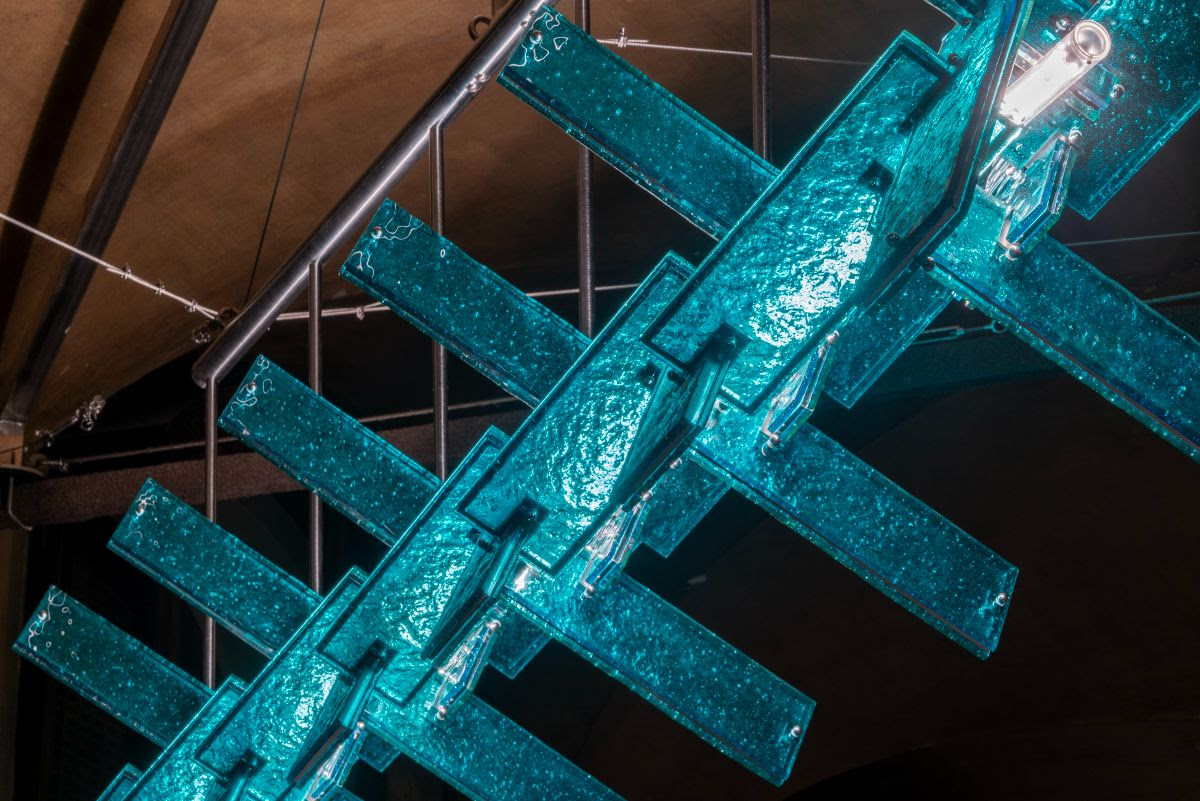
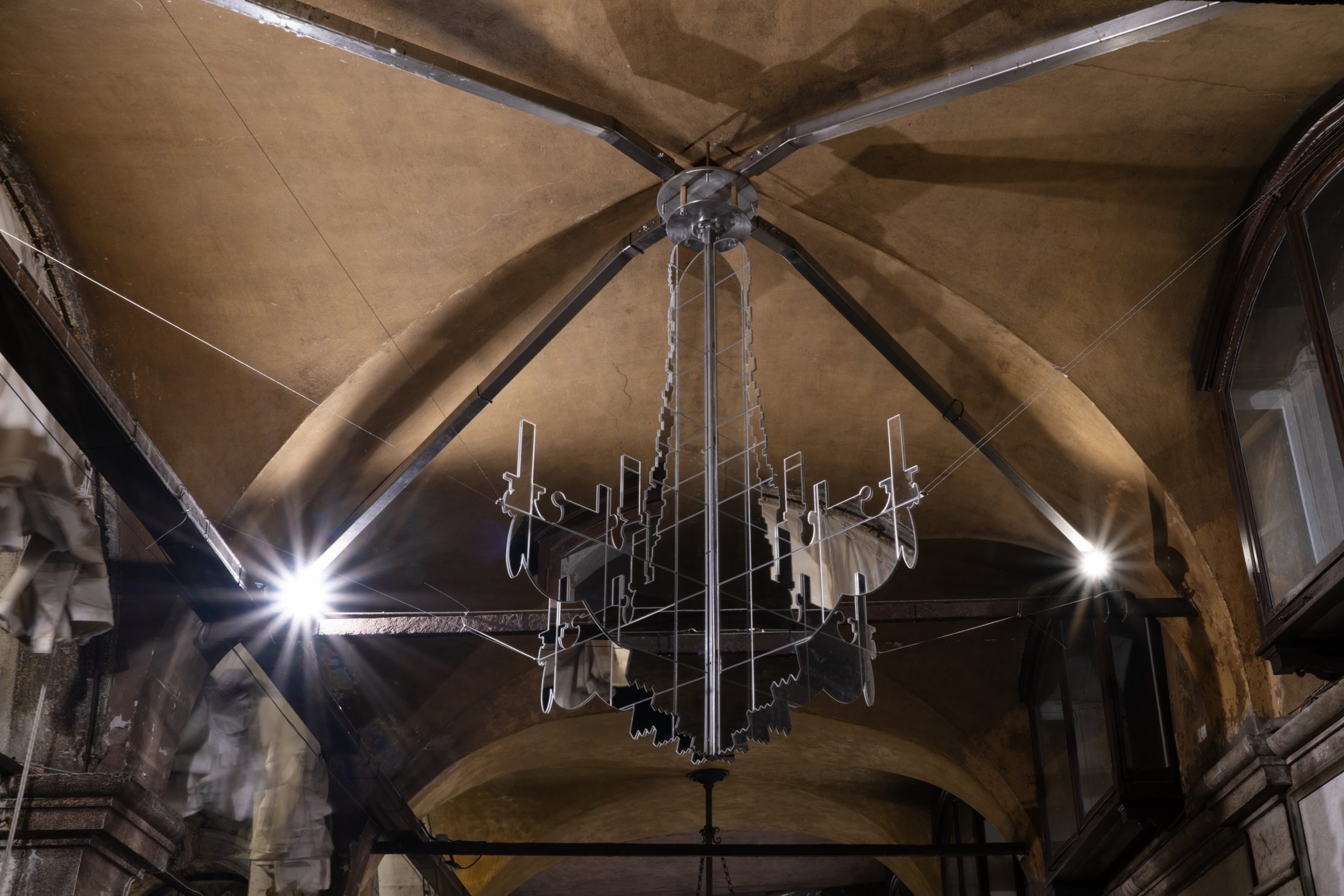

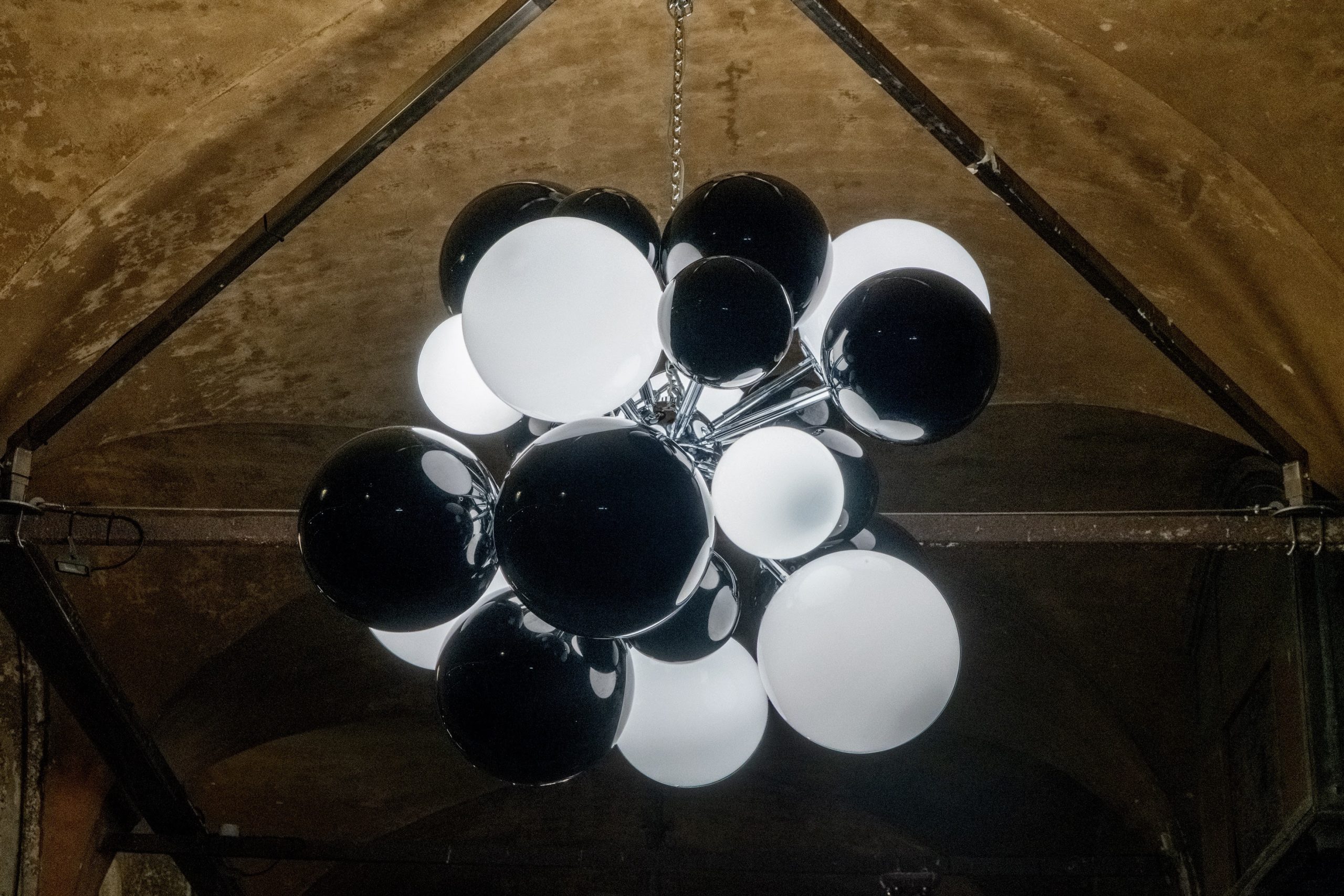
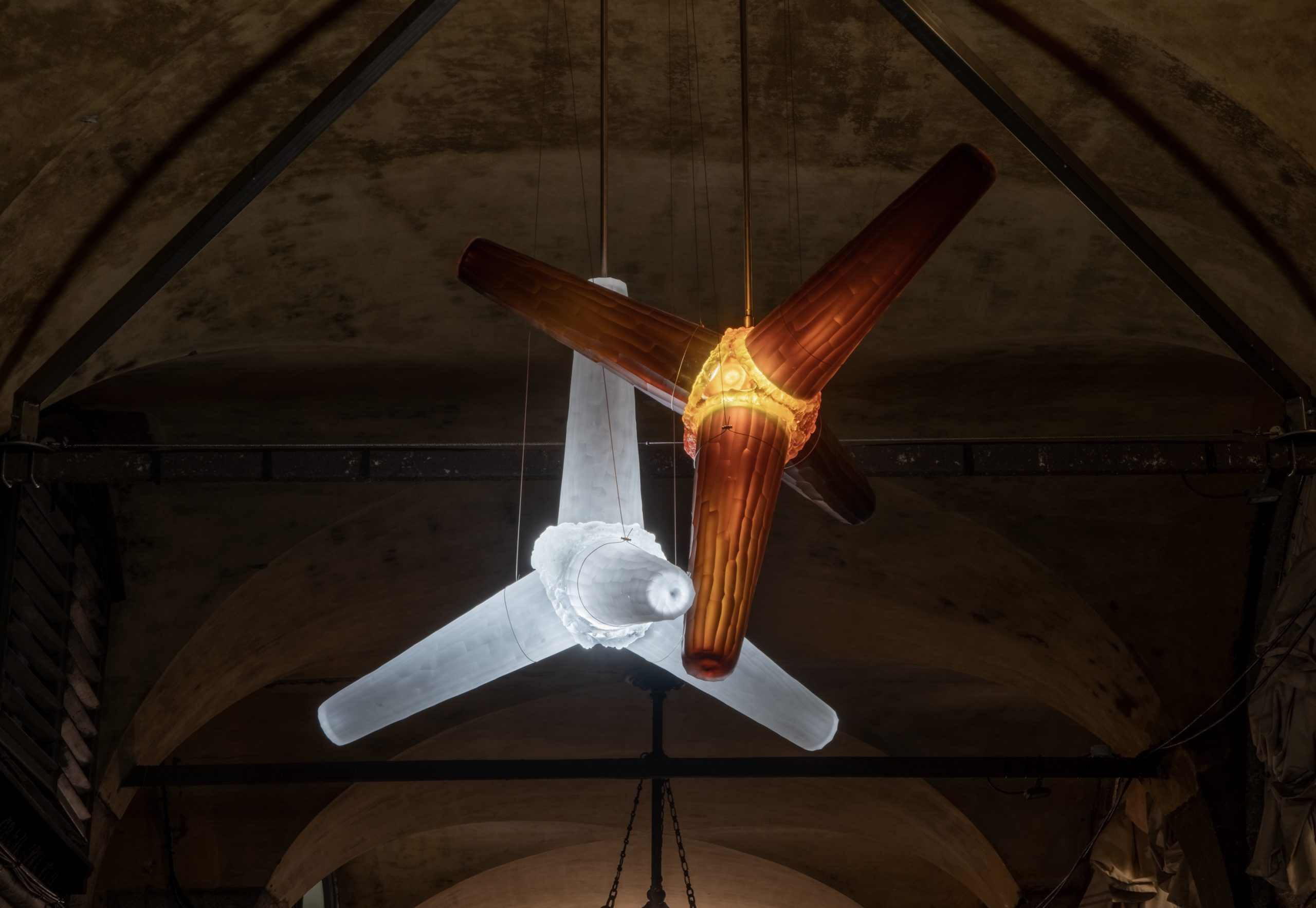


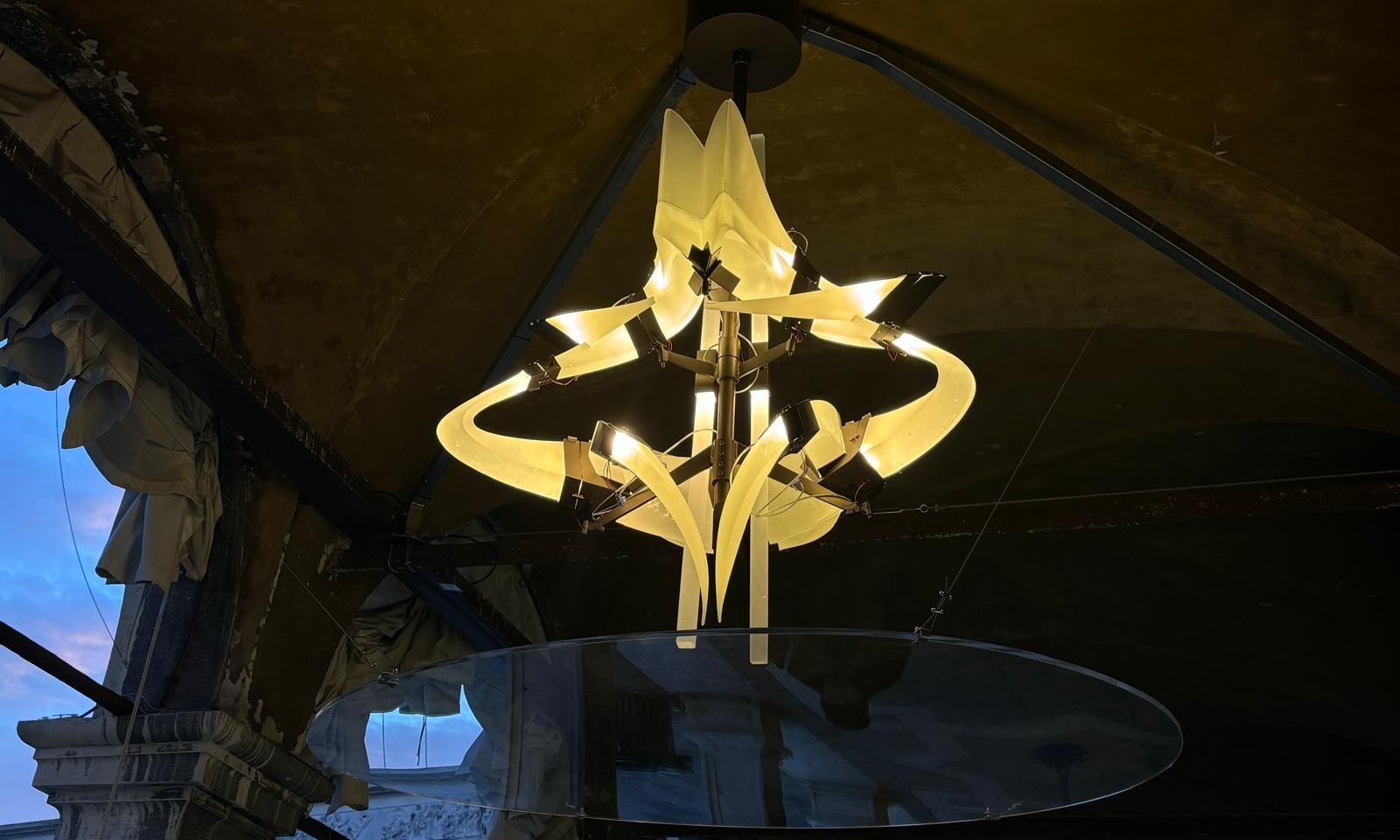

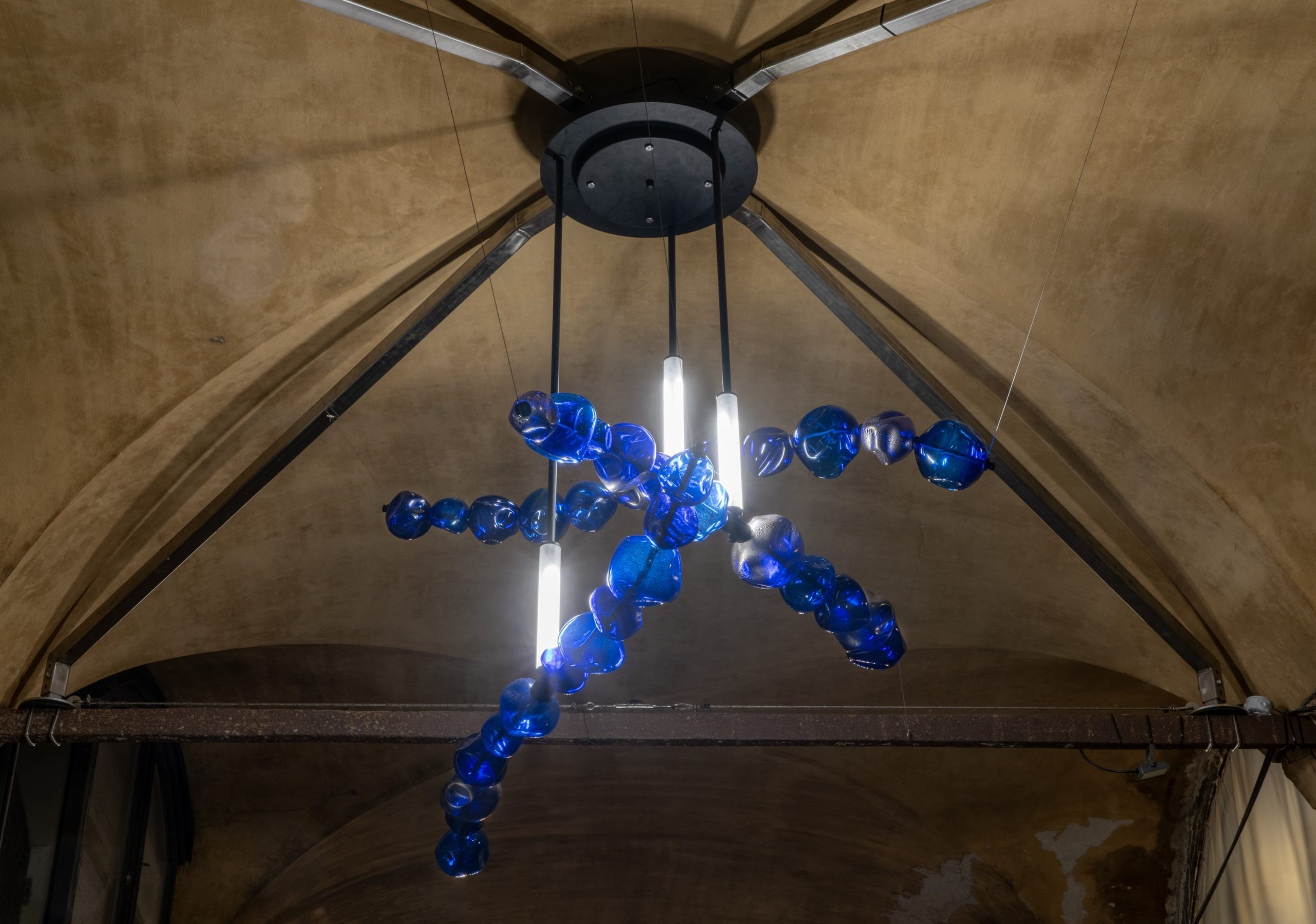
Photo credit: Giorgio Bombieri